
Are Competition Winnings Taxable in the UK? (2026 Guide)
Here’s the good news, right up front: for most of us in the UK, winnings from a competition, a lottery ticket, or a casual bet are completely tax-free. You can think of it as a lucky windfall rather than a regular paycheque.
Of course, it’s never quite that simple. The straightforward rule can get a bit more complicated if your winnings start to look like a main source of income, or if you're what HMRC might consider a professional.
The Core Rule for UK Prize Winnings
For the average person who enters a competition for a bit of fun, the rules are thankfully clear. HMRC doesn't see prizes from games of chance as 'income' in the traditional sense. So, whether you pocket £50 from a prize draw or scoop a life-changing £50,000, you generally get to keep the lot without setting anything aside for the taxman.
This is a fundamental principle in the UK's approach to tax on gambling and prizes. The logic is that these are 'windfalls'—unexpected gains that aren't the result of employment or running a business. It’s why the vast majority of prize winners can pop the champagne without having to fill out a tax return.
Winnings That Are Usually Tax-Free
Most of the prizes you’re likely to encounter fall squarely into this tax-free category. This includes:
- National Lottery Jackpots: Any winnings from the National Lottery, big or small, are tax-free.
- Cash Prize Draws: That money you won from an online competition, a local raffle, or a social media giveaway? It's typically yours to keep, no tax due.
- Betting Gains: For casual punters, money won from backing a horse or placing a bet on the football is not subject to tax.
The crucial difference here is between luck and labour. HMRC views most winnings from betting and lotteries as gambling income, which isn't liable for Income Tax or Capital Gains Tax. This means the prize money itself has no immediate tax liability. For a deeper dive into HMRC's official stance, you can read an overview of prize money taxation from Vision Consulting.
Key Takeaway: If winning prizes is just a hobby or a one-off stroke of luck, you don't need to declare it. The prize is yours to enjoy, tax-free at the point you receive it.
However, it's really important to know the handful of situations where this rule doesn't apply. The line gets drawn when the activity stops looking like a hobby and starts to look more like a business, which we’ll get into next.
Why Most Prize Winnings Are Tax-Free

So, you've hit the jackpot on the lottery or won a prize on social media. The big question is, does HMRC get a slice? The short answer, for most people, is a relieving no. This all comes down to a simple but crucial distinction in the UK tax system: it separates sheer luck from earned income.
For the vast majority of us, winning a prize is a matter of chance. It's not a job, a trade, or a reliable stream of cash. Think of it like finding a £20 note on the street – it's a happy one-off, not part of your monthly salary. HMRC sees prizes from lotteries, raffles, and most prize draws in exactly the same way.
These winnings are classed as gambling proceeds. Because the outcome is entirely uncertain, they simply fall outside the scope of both Income Tax and Capital Gains Tax. This holds true whether you’ve won cash, a shiny new car, or a dream holiday. The prize is considered a capital receipt, and with no specific law to tax it, it’s all yours at the moment you receive it.
The Tax Catch After the Win
While the initial prize is safe from the taxman, there's a little detail you absolutely need to know. The tax-free status applies only to the prize itself, at the very moment you win it. Any income that your prize generates down the line is a completely different story and will almost certainly be taxable.
Let's say you win £100,000 in a cash competition. That £100,000 lands in your account, free and clear. Fantastic. But if you then put that money into a high-interest savings account, the interest it earns each year is new income. This interest is subject to Savings Tax, just like the interest on any other savings you might have.
The same logic applies to physical prizes. Imagine you win a car:
- The Win: Getting the car itself is a tax-free event. No tax is due.
- The Sale: If you decide to sell the car later for more than you acquired it for (its value when you won it), that profit could attract Capital Gains Tax.
- Renting It Out: If you were to rent the car out to make some extra money, that rental income would be taxable.
This principle is key: The prize is a tax-free windfall, but the 'fruit' it produces thereafter (like interest or rental income) is taxable.
Inheritance Tax Implications
For very large wins, there's another long-term factor to consider: Inheritance Tax (IHT). While your winnings aren't taxed when you receive them, they immediately become part of your estate.
This means if the total value of your estate, including your prize money, is over the IHT threshold (currently £325,000), your heirs could face a 40% tax bill on the excess when you pass away. It's also worth noting that gifting large sums from your winnings can have IHT implications if you die within seven years of making the gift.
When Winnings Become Taxable Income
The lovely, straightforward rule about tax-free prizes isn't set in stone. There’s a crucial tipping point where the taxman might start taking an interest, and it all comes down to the line between a casual hobby and a professional operation. If your competition entries become so frequent and organised that they start to look like a business, then your winnings could well be classed as taxable income.
This isn’t about a single, life-changing win. It’s about the pattern of your activity over time. Think of it like this: someone buying a lottery ticket on a Saturday is clearly relying on luck. But a professional poker player who studies the game, manages a bankroll, and travels to tournaments for a living? That’s a trade. The same logic applies here.
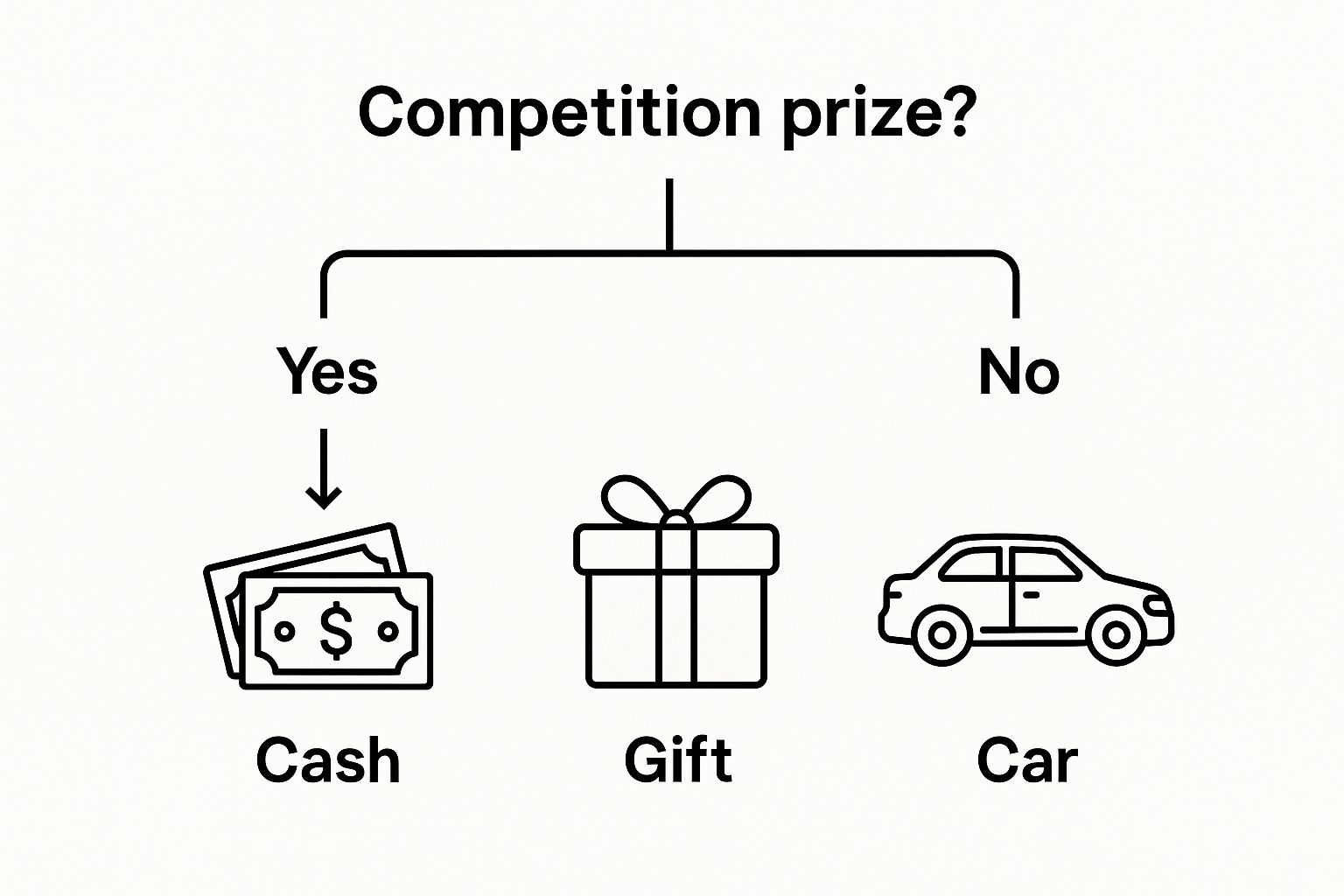
While the type of prize itself—whether it's cash, a car, or a holiday—doesn't usually change the tax situation, the way you go about winning it is what really matters to HMRC.
The Badges of Trade Explained
So, how does HMRC decide if your hobby has become a business? They use a set of guidelines called the 'badges of trade'. These aren't hard-and-fast rules, but more like a checklist of indicators. If your 'comping' activities tick several of these boxes, they can build a picture of a commercial enterprise, and you may need to start declaring your earnings.
Some of the key badges of trade include:
- An intention to profit: Is your main goal to make money to live on, or are you just entering for a bit of fun?
- The number of transactions: Are we talking about a few entries a month, or are you systematically entering hundreds or thousands in an organised way?
- The nature of the asset: This is less common with prizes but involves acquiring something with the clear, sole intention of selling it on for a quick profit.
- Organisation and skill: Do you use special software to manage your entries? Do you set aside specific hours each day for 'comping'? Do you have a particular skill, like being a professional quizzer, that gives you a significant advantage?
If your activities start to look more and more like this, your prizes stop being tax-free windfalls. They become trading profits.
This means the answer to the question of whether competition winnings are taxable can flip from a simple 'no' to a firm 'yes', purely based on your behaviour. At this stage, you're effectively considered self-employed in the eyes of the taxman.
Making the Declaration
If you’ve realised your comping has crossed the line into a trade, you have a legal responsibility to report this income. This involves registering for Self Assessment and filing a tax return every year.
On your return, you would declare your total winnings as income. The good news is you can also deduct any legitimate expenses you incurred while generating that income, like the cost of entry fees or subscriptions to competition-finding websites. This makes sure you're only paying tax on your actual profit, turning a potentially daunting situation into a clear, manageable process.
Tax on Winnings for Professional Athletes and Entertainers
When winning becomes your job, the tax rules get a lot more serious. For professional athletes, esports champions, and high-profile entertainers, prize money isn't just a bit of good luck – it's their income. HMRC sees it as payment for their skill and hard work, just like a salary.
This isn't just a rule for UK residents, either. Think of a global tennis star winning at Wimbledon or a foreign singer taking home the prize from a UK talent show. Because they earned that money for a performance on UK soil, it’s subject to UK tax. For this group, the question "are competition winnings taxable?" has a very clear and definite answer: yes.
How Professionals Pay Tax on Their Winnings
For professionals, tax is usually taken care of right away, not something they have to sort out months later. The event organiser or company paying out the prize money is required by law to deduct tax before the winner gets paid. This is a system known as Withholding Tax.
The UK is quite unusual in this respect. It not only taxes the prize money from the UK event but can also tax a slice of the person's global endorsement income related to their UK performance.
Let's imagine a golfer wins £50,000 at a UK tournament. The organiser will withhold tax, typically at the basic rate of 20% (£10,000), and pay it straight to HMRC. The golfer then receives the remaining £40,000. If you want to dive deeper, there's more information on the specific tax obligations for sportspeople in the UK.
This system is a practical way to ensure tax is collected, particularly from international stars who might not be fully up to speed with the UK's tax system. But that initial 20% deduction isn't always the end of the story.
Key Insight: Prize money is business income for a professional. The withholding tax is just an initial payment. Depending on their total earnings, they might need to file a UK tax return to pay more, or in some situations, they could even be due a refund.
It’s Not Just About the Prize Money
The UK's tax rules for performers and athletes are famously thorough. HMRC doesn't stop at the prize money. It also considers the massive global sponsorship deals that top-tier individuals command. A portion of that income can also be taxed in the UK.
So, how does that work? The tax authorities 'apportion' the endorsement income. They calculate how much is attributable to the time spent competing or performing in the UK versus their activities elsewhere in the world. This can pull in:
- Appearance Fees: Payments made just for showing up.
- Prize Winnings: The reward for their performance.
- Sponsorship Income: A calculated percentage of their income from major brands like Nike or Adidas, linked directly to their UK appearance.
This all-encompassing approach makes it crystal clear: a casual lottery win is worlds away from the earnings of an elite professional. For those at the very top of their game, winning is a profession, and managing the resulting tax obligations is a critical part of their business.
How Foreign Athletes Are Taxed in the UK

When an international sports star steps onto UK soil to compete, their tax situation gets a lot more complicated than that of a lucky winner from our instant win competitions UK. You can bet their earnings are squarely on HMRC's radar. The UK doesn't just tax the prize money they win here; it also claims a slice of their global endorsement and sponsorship income.
So, how does that work? HMRC uses a method called 'apportionment' to figure out what portion of an athlete's worldwide income is reasonably tied to their UK performance. At its heart, the system works on a simple principle: the time an athlete spends performing and promoting in the UK dictates their UK tax bill.
The Apportionment Methods Explained
HMRC offers athletes a choice between two main formulas to work out this taxable slice. This isn’t just a minor detail—the method they pick can dramatically change how much tax they end up paying. The two options are the 'Relevant Performance Days' method and the 'Relevant Performance and Training Days' method.
-
Relevant Performance Days (RPD) Method: This one is the more straightforward of the two. It simply compares the number of days an athlete performs in the UK to their total performance days across the globe for that year.
-
Relevant Performance and Training Days (RPTD) Method: This calculation is a bit more involved. It considers all days spent performing and training in the UK against the total number of performance and training days worldwide.
Choosing the best method really boils down to the individual athlete’s schedule. Someone who spends a significant amount of time training outside the UK might find the RPTD method more favourable, as it could lead to a smaller percentage of their income being taxed here.
To see this in action, picture a non-UK resident tennis player who competes for 100 days worldwide, with 10 of those being at a UK tournament. Under the RPD method, 10% of their endorsement income would be subject to UK tax. But what if they also spent 200 days training abroad? The RPTD method would factor in those extra days, potentially reducing the taxable portion of their income significantly.
Why Meticulous Records Are Crucial
As you can imagine, this system places a massive emphasis on keeping accurate records. For a touring international athlete, every single day counts, quite literally. To justify their chosen calculation method and prove they're paying the right amount of tax, they need to maintain detailed logs of their movements.
This means keeping a precise diary of their global whereabouts, which must include:
- Travel days to and from the UK
- Specific days spent training in the UK
- Competition days in the UK
- Any days spent on promotional or media activities in the UK
Without these detailed records, an athlete could easily face a challenge from HMRC and end up with a much larger tax bill than necessary. For the world's elite sportspeople, knowing that their winnings are taxable is just the first step—navigating the complexities of apportionment is where the real challenge lies.
Reporting Your Winnings and Next Steps
So, you've figured out whether your prize is taxable. What now? For most people who get lucky with a one-off win from a prize draw or the lottery, the answer is wonderfully simple: absolutely nothing. You can just enjoy your winnings without a single thought about contacting HMRC.
But things change if your situation is a bit more involved. If your winnings come from an activity that HMRC could view as a trade—or if you're a professional athlete or entertainer—the law requires you to declare this income. This is where the Self Assessment tax return comes into play.
If you’ve never done this before, you'll need to register for Self Assessment with HMRC. It's really important to keep an eye on the deadlines, as filing late can lead to frustrating penalties. Remember, the UK tax year runs from 6 April to 5 April, and the deadline to file your return online is usually 31 January of the following year.
Your Action Checklist
To make it easier, here’s a quick checklist to guide you on what to do next:
- Assess Your Activity: Was this just a casual, one-off entry, or do you enter competitions regularly and in an organised way?
- Determine Your Status: Think of yourself as a hobbyist, a professional sportsperson, or an entertainer. Your answer is the key to understanding your tax duties.
- Check for 'Badges of Trade': If you’re entering competitions systematically with a clear intention to make a profit, you’ll likely need to declare what you win.
- Register if Necessary: If you fit into a category that needs to pay tax, get registered for Self Assessment as soon as you can to avoid any last-minute rush.
- Seek Professional Advice: When you're in any doubt, especially with a big or unusual win, talking to a tax professional is always money well spent.
For many, winning prizes is a fun hobby, and it's helpful to know how to approach it effectively. To get started, you might find our guide on how to enter a competition a useful resource for your future entries.
Your Top Questions Answered
Winning a prize is exciting, but the question of tax often pops up straight away. Let's clear up some of the most common queries people have so you know exactly where you stand.
What if I Win a Car or a Holiday Instead of Cash?
Good news! If you win a non-cash prize like a car or a holiday in a typical prize draw, the prize itself is not subject to Income Tax. HMRC doesn't see this as earnings; its value is simply its market value at the time you won.
However, it's what you do next that matters. Say you win that car and decide to sell it a year later for a profit. That profit could potentially be subject to Capital Gains Tax. So, while the win itself is tax-free, any future income you make from it isn't.
Do I Pay Tax on Winnings from Online eSports Competitions?
This one really boils down to whether you're a professional or just playing for fun. For a casual gamer who enters a one-off tournament and gets lucky, that prize money is usually considered a tax-free windfall from a hobby.
The tables turn completely for professional eSports players. If you have sponsorships, pull in a regular income from competing, and essentially treat gaming as your career, then your winnings are taxable. HMRC views it as income from your trade, which must be declared on a Self Assessment tax return.
The Key Distinction: HMRC draws a clear line between a hobby and a trade. If winning prizes is your job, that money is taxable income. If it’s just for fun, it’s usually a tax-free gain.
Are Winnings from a TV Game Show Taxable?
For almost everyone who appears on a TV game show as a one-off contestant, any winnings are treated as a tax-free windfall here in the UK. Appearing on a show like The Chase or Who Wants to Be a Millionaire? isn't considered a job or a trade by the taxman.
The exception? If you were to somehow become a 'professional contestant' or if the appearance was part of your existing career as a media personality, the prize money could then be classed as taxable income. As with most things tax-related, the context of the win is everything.
Ready to try for your own big win? At Lucky Turbo Competitions, we have a fantastic range of draws for everything from tax-free cash to the latest tech. Find your next draw in our competitions or try instant win games today!