

KYC Checks: How UK Instant-Win Sites Verify Big Payouts
You've just watched a number roll up that could actually change your month, maybe your year. Before that money lands in your bank account, though, almost every legitimate UK site puts you through a verification process most players have never read the terms on. We looked at how this actually works, why it exists, and what it should look like when a site is doing it properly.
What actually happens after you win a big cash instant-win prize?
Winning the game and receiving the money are two separate events, often separated by days. The instant part of 'instant win' refers to finding out you've won, not to the cash appearing in your account. Behind the scenes, a claim gets flagged, a support or compliance team reviews it, and only once that review clears does a payment get released.
The moment of winning vs the moment of paying
Small prizes, a few pounds here and there, tend to move fast because the financial and fraud risk is low. Once a win crosses a certain threshold, usually somewhere in the low hundreds of pounds and almost always above £500, the process slows down deliberately. That's not the site being difficult; it's the point where anti-fraud and anti-money-laundering rules start to apply properly.
Who checks the win before money moves
On most sites this isn't automated. A person on a compliance or payments team looks at the account: how it was funded or entered, how old it is, whether the details match, and whether anything about the pattern of play looks unusual. For a genuine player who entered normally, this is a formality. For an account created minutes before a big win, or with mismatched names and addresses, it's the stage where things get held up while questions get asked.
What is KYC and why do UK instant-win sites need it?
KYC stands for 'Know Your Customer' and it's a legal requirement, not a company preference. Any UK business handling money above certain thresholds, including gambling and gambling-adjacent operators, has to confirm who its customers actually are under money laundering regulations. This sits alongside, not instead of, the Gambling Commission's licence conditions for operators that hold a gambling licence.
The practical reason is simple: cash prizes are an attractive route for laundering money or for fraudsters using stolen card details to fund entries. A KYC check confirms that the person claiming the prize is a real, identifiable adult, that the payment details belong to them, and that the funds used to enter (where entries are paid) came from a legitimate source. It also protects genuine winners, because it makes it much harder for someone else to intercept a payout meant for you.
Sites that skip this entirely for large sums should make you uneasy, not relieved. A £5,000 payout with no ID check anywhere in the process is a bigger red flag than a payout that takes an extra 48 hours because someone actually looked at your documents. We'd rather wait two days for a properly checked payment than get a same-day one from an operator that clearly doesn't run any compliance process at all.
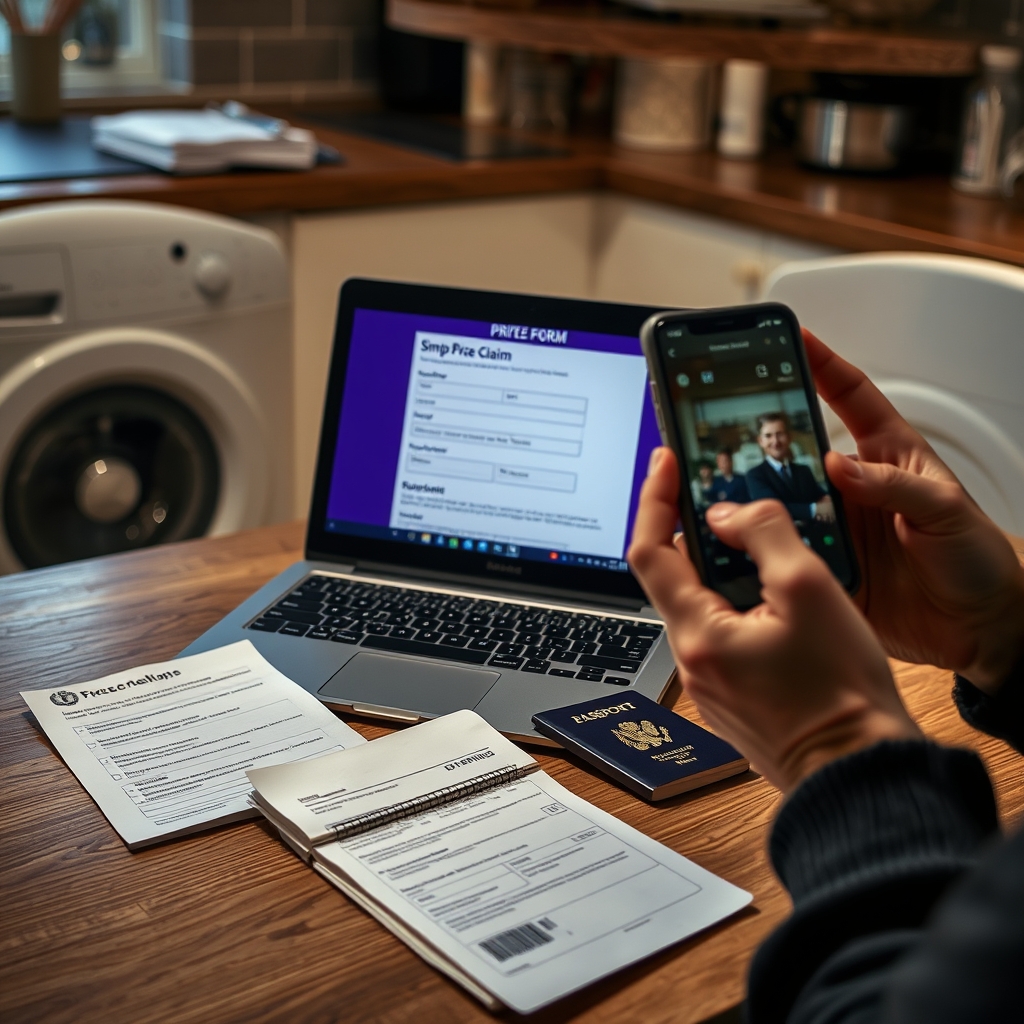
What documents will you actually be asked for?
Expect a photo ID, a proof of address, and increasingly a live selfie or short video to prove you're a real person. The exact combination varies by operator and by how much you've won, but these three categories cover almost every request we've seen described across UK instant-win and prize draw operators.
Proof of identity
A passport or a full UK driving licence is the standard. Some sites will accept a national ID card for non-UK residents where relevant. The document needs to be current, not expired, and the name on it has to match the name on the account exactly, including middle names in some cases.
Proof of address
This is usually a recent bank statement, a council tax bill, or a utility bill dated within the last three months. Mobile phone bills are sometimes rejected because they're considered easier to fake or less tied to a fixed address. If your name has changed recently, or you've just moved, this step is where most delays actually happen, so it's worth having a current document ready before you claim anything.
Selfie or liveness checks
More sites now ask for a short selfie video, sometimes holding the ID document next to your face, matched against the photo using automated facial recognition software. This isn't unique to competitions; it's the same technology banks and crypto exchanges use. It exists to stop someone using a stolen or borrowed ID to claim someone else's win.
Why do withdrawal limits exist, and how big can they be?
Withdrawal limits are set to slow down large or unusual payments so fraud checks have time to work, and they vary hugely between operators. A limit isn't necessarily a sign the site can't afford to pay you; more often it's a risk-management tool that caps how much can move in a single transaction or a single day.
Daily vs per-transaction limits
Some operators cap how much you can withdraw in one go, say £2,000 per transaction, but allow multiple transactions across several days with no overall ceiling. Others set a monthly cap that applies regardless of how the payment is split. This matters if you win a genuinely large prize, because a £20,000 win might legitimately take two or three separate payment runs to clear in full, not because the money isn't there, but because the limit structure spreads it out.
Why bigger wins take longer to clear
The bigger the sum, the more scrutiny it attracts, both from the operator's own compliance team and, in some cases, from their banking partner. Banks themselves run their own fraud checks on large incoming transfers, and a payment that looks unusual to a receiving bank can get held for review independently of anything the competition site does. This is one of the more common reasons a payout takes longer than either side expected, and it's worth knowing before you assume the site is stalling deliberately.

How long should a large payout realistically take?
A well-run site should tell you a specific working-day window in its terms, typically somewhere between 3 and 28 days for larger sums, and stick to it. Small instant prizes, credited automatically, often land within minutes or hours. Anything requiring manual review and KYC checks moves on a different clock entirely.
What we'd want to see, and what you should look for before you enter anywhere with real cash prizes, is a clearly stated payout timeframe in the terms and conditions, not a vague 'as soon as possible'. Genuine operators publish this because they know exactly how their own compliance process runs. If the terms are silent on timing altogether, that silence is itself useful information.
It's also worth separating 'slow because of checks' from 'slow because of stalling'. A site that responds to queries, gives you a named reason for a delay (an ID resubmission, a bank detail mismatch, a name discrepancy) and gives you a revised date is behaving normally. A site that goes quiet, stops answering support tickets, or keeps asking for 'one more document' with no end in sight is behaving very differently, and that pattern shows up repeatedly in complaints about the worst operators in this space. For a wider look at how to spot a site that's unlikely to pay out cleanly at all, our piece on signs of a legitimate UK prize draw covers the warning signs in more detail.
Are gambling-licensed instant wins checked differently to free prize draws?
Yes, gambling-licensed sites operate under Gambling Commission rules with formal source-of-funds obligations, while free prize draws sit under general consumer and gaming law instead. Both can and should still run identity checks on winners, but the legal machinery behind them isn't the same.
Gambling Commission-licensed operators
Where an instant-win game is classed as gambling because there's a stake or payment to play, the operator needs a Gambling Commission licence. That comes with specific social responsibility and anti-money-laundering conditions, including 'source of funds' checks for larger winners, meaning they may ask where the money you used to play actually came from, not just who you are.
Free prize draws and postal entry routes
Sites like Lucky Turbo run as free prize draws with a genuine no-purchase-necessary postal entry route, which is what keeps them outside gambling law under the relevant exemptions. That doesn't remove the need for identity checks on winners; it just means the checks are driven by fraud prevention and consumer protection rather than a gambling licence condition. If you're comparing how different instant-win formats actually pay out day to day, it's worth reading our breakdown of how instant-win cash prizes are paid in the UK alongside this one.
What red flags suggest a site will drag its feet on a big win?
The clearest warning sign is a site that never mentions verification at all until after you've won. Legitimate operators tell you upfront, in the terms you can read before you ever enter, that ID checks apply to winners above a certain value. If that information only appears once you're chasing a payout, treat it with caution.
Signs to watch before you enter
Look for a published company name and registration number, a physical UK address, a stated payout timeframe, and terms that explain the verification process in plain language rather than dense legal boilerplate. Check whether the site has an active, responsive social media presence with genuine winner interactions, not just polished graphics. Search for the operator's name alongside words like 'complaint' or 'refund' before you commit any money, and see what pattern comes up.
Other recurring red flags include: requests for payment to 'release' your prize (a genuine win never requires you to pay a fee to receive it), pressure to act within an unusually short window, and support that only communicates through a single social media DM channel with no traceable business record behind it. None of these guarantee a scam on their own, but stacked together they're a pattern worth walking away from. Our guide to browsing current UK cash prize competitions is a reasonable way to compare how established operators present their terms side by side.
How do verification practices compare across different types of site?
The strictness and speed of verification tends to track the type of operator, not just the size of the prize. The table below sets out the general pattern we'd expect across the main categories of UK instant-win and prize draw site, based on how each type is structured and regulated rather than on a single named brand.
| Site type | Typical KYC requirement | Typical time to clear a large win | What sets the withdrawal limit |
|---|---|---|---|
| Gambling Commission-licensed instant-win game | Full ID, address proof, and source-of-funds for large wins | Several days to a few weeks | Licence conditions and the operator's own risk policy |
| Free prize draw with postal entry (Lucky Turbo model) | ID and address proof for winners above a set value | Days to around a month, as stated in terms | Operator's internal fraud policy, not a gambling licence |
| Social media 'giveaway' with no clear operator | Often none, or informal and inconsistent | Unpredictable, frequently indefinite | Undefined, or non-existent |
| Society lottery-style instant win | Full ID under gambling and lottery regulation | Set by licence conditions, often clearly published | Regulated payout schedule |
The pattern is consistent across all four rows: the more clearly a site is structured and regulated, the more predictable its verification and payout process becomes. The category to be most careful of is the third one, where there's no licence, no registered company detail, and no stated process at all. That's not automatically fraudulent, but it removes almost every mechanism you'd otherwise have to complain or escalate if a payout goes wrong.
What should you do if you can't or won't hand over ID documents?
You're entitled to ask why a document is needed and to query the process, but refusing entirely will usually mean a legitimate prize can't be paid. This isn't the site being awkward; it's the same rule that stops your bank paying out a large sum to someone it can't identify.
If a request feels excessive relative to the prize, for example being asked for a full passport, three separate proof-of-address documents and a video call for a £50 win, that's disproportionate and worth questioning directly with the operator before you send anything. A reasonable operator will explain, in plain terms, why each document is needed and how long it will be kept, in line with UK data protection law. You can also ask what happens to your documents afterwards; a proper privacy policy should say they're deleted or securely retained for a defined period, not kept indefinitely for unrelated use.
If you genuinely believe you're being asked for more than is reasonable, or a site is stalling without explanation, you can raise a complaint with the operator in writing first. If that gets nowhere and the operator holds a gambling licence, the Gambling Commission's guidance explains how to escalate a dispute. For tax questions on prize winnings, note that most UK competition and lottery prizes aren't taxable income for the winner, but HMRC's own guidance is the correct source if your situation is unusual, not a blog post.
How does Lucky Turbo handle verification for winners?
We run as a free prize draw with a genuine postal entry route, and winners of cash prizes go through an identity check before payment is released. That means confirming who you are and that the payment details you've given us actually belong to you, in line with standard UK consumer protection practice for prize operators.
We'd rather a winner waits a short, clearly stated amount of time and gets paid correctly than have a process so loose it invites fraudulent claims against genuine winners' prizes. If you're new to how the free entry side of this works, our plain-English explainer on what instant-win games actually are sets out the mechanics before you play a single game, and our current instant-win listings show live prizes and their terms upfront rather than after you've already won. Play within your means, treat every entry as entertainment rather than income, and keep in mind that no legitimate site can promise a specific outcome; verification exists to protect the payout, not to guarantee it in the first place.
Frequently Asked Questions
How long does KYC verification usually take for a big instant-win prize?
What documents do I need to claim a large cash prize in the UK?
Is it normal for a competition site to ask for ID before paying out?
Can a site refuse to pay me if I won't share personal documents?
Do I have to pay tax on UK competition or instant-win winnings?
Try an Instant Win
Scratch cards, spin the wheel, coin flips — find out instantly if you've won.
Browse Instant Wins